Even a properly configured press brake may develop issues such as angle inconsistency and dimensional drift over time if not maintained properly. This article will detail the primary factors affecting press brake accuracy and how to establish an effective preventive maintenance system.
Why does press brake accuracy drift over time?
A decline in a press brake’s accuracy typically does not occur suddenly. Instead, it results from the gradual accumulation of issues over time, such as mechanical wear, insufficient lubrication, loose fasteners, unstable backgauge positioning, degraded hydraulic fluid quality, and control parameter deviations. These problems often manifest first in the quality of the finished product. When bent workpieces exhibit inconsistencies in angles, positioning deviations, or angle inconsistency between the center and ends of long workpieces, it indicates that the equipment’s condition is becoming unstable.
What are the main factors affecting bending consistency?
Tooling wear and inconsistent clamping
Since the tooling comes into direct contact with the workpieces, the condition of the tooling directly affects the bending angle and dimensions. Tooling wear, mixing tooling from different batches, a dirty tooling surface, and unstable clamping can all lead to angle inconsistency.
Backgauge repeatability
Issues with the backgauge often stem not from large single-positioning errors, but from inconsistent repeatability, which causes errors to accumulate over time. Backgauge repeatability is particularly critical when processing multi-step workpieces such as box-shaped parts, multi-bend parts, flanged parts, and assembled components.
Crowning settings and machine frame deformation control
When bending long workpieces, elastic deformation of the ram and lower worktable becomes significant. If crowning is insufficient, excessive, or improperly configured, there is often angle inconsistency at the center and ends of the long workpiece. Therefore, the crowning system is crucial for maintaining angle consistency along the entire length of the workpiece.
Drive and motion control stability
For hydraulic or servo-hydraulic press brakes, hydraulic pressure stability, valve response, oil temperature fluctuations, and ram synchronization all affect ram positional repeatability and forming consistency. For electric press brakes, greater attention must be paid to the stability of the servo drive, encoder feedback, and motion control parameters.
Material batch variations and fluctuations in sheet thickness/strength
Even when the equipment is operating normally, fluctuations in sheet thickness, variations in strength, and changes in the rolling direction across different material batches can affect springback and the final angle consistency. Therefore, when troubleshooting accuracy issues, one must not focus solely on the equipment but also consider variations in the material itself.
Items to be inspected daily, weekly, and periodically
Daily inspections
Before each tool change or bending operation, clean the tooling surface to ensure it is free of metal shavings and oil residue;
Check that the clamping system is secure and that the tooling is clamped firmly;
Check the guideways, lead screws, and lubrication system in accordance with the manufacturer’s manual, and lubricate them as specified; do not top up lubricant arbitrarily;
While the equipment is running, listen for any abnormal noises;
Compare the first and last qualified parts produced in each shift to check for any drift in angles or dimensions.
Weekly inspections
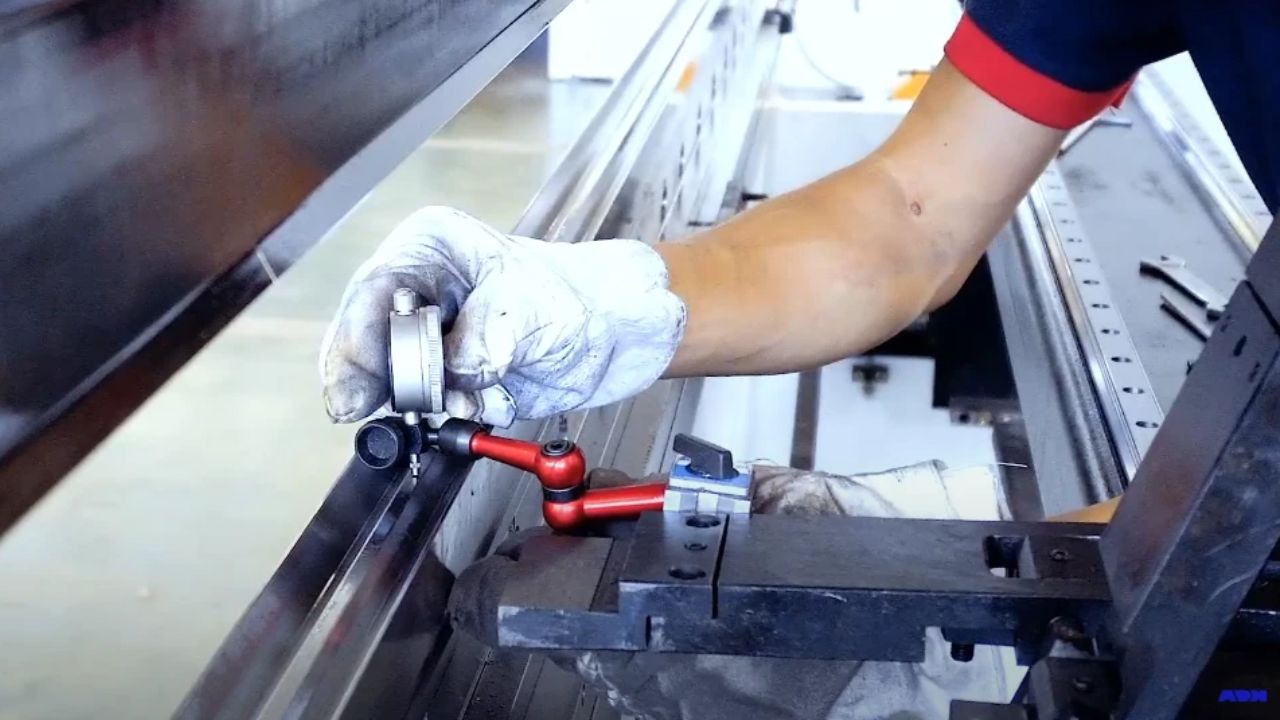
Move the backgauge through its full stroke several times to observe whether its operation is stable and if there is any sticking;
Check the guide rails for scratches or rust, and inspect fasteners for looseness;
Run a standard program to bend a standard part and verify that the accuracy matches that of previous standard samples.
Conduct spot checks on commonly produced workpieces to check for significant fluctuations in dimensions and angles.
Regular preventive maintenance
Every 3–6 months, check the hydraulic oil level, temperature, contamination level, and appearance;
Regularly determine the replacement intervals for hydraulic oil and filter elements based on the equipment manual, operating loads, and oil test results.
Regularly inspect the condition of seals to prevent oil leaks from cylinders and other components.
Conduct a professional accuracy check on the ram and backgauge every six months or once a year;
Archive records of each maintenance session.
How to establish a truly effective preventive maintenance system
Preventive maintenance should not consist solely of repair work; it should also include fixed inspection items
Preventive maintenance should not involve repairs only after a failure occurs; rather, it should establish a systematic condition management process before failures occur. Recording and conducting daily, weekly, and periodic inspection items allows many issues to be detected and resolved at an early stage.
Maintenance records should be correlated with workpiece quality performance
The value of maintenance records is typically reflected in workpiece quality performance. For example, did angle issues improve after changing the hydraulic oil? Did repeatability stability improve after calibrating the backgauge? Which types of workpieces were the first to exhibit problems? By analyzing these performance metrics, we can see the importance of maintenance in ensuring production quality.
Manufacturer-published documentation can serve as a reference, but should not be the sole basis
Technical documentation published by equipment manufacturers can serve as a reference when establishing a maintenance system, for example, the [RAYMAX official website]. However, these public materials should only be used as a foundational reference. Ultimately, a maintenance system tailored to the specific factory must be established by integrating the equipment’s configuration, actual operating conditions, types of workpieces, and on-site experience.
Signs that maintenance is overdue
Repeated angle adjustments on the same workpiece
If you need to repeatedly adjust the angle while bending the same batch of workpieces, this indicates that at least one of the following has fluctuated: equipment condition, tooling condition, material consistency, or parameter management. A systematic investigation is required.
Increasing reliance on operator experience for angle compensation
A machine should inherently achieve stable production through standard procedures, standard tooling, and standard compensation values. If the operating process increasingly relies on the experience of senior operators, it indicates that the machine’s stability has already been compromised.
Long workpieces or appearance-critical workpieces are more likely to reveal issues first
Long workpieces and appearance-critical workpieces are more sensitive to angle consistency along their entire length and surface condition, amplifying bending issues. Therefore, when the pass rate for these products declines, it indicates that the press brake’s precision has already been compromised.
Conclusion
The purpose of press brake maintenance is not merely to prevent equipment failures, but to keep angle consistency, positioning repeatability, full-length consistency of long workpieces, and rework rates within reasonable limits. We must shift our maintenance mindset from “repairing after failure” to “proactive management” to ensure the stable, long-term operation of the press brake.